Field Notes
Moon Phases and the Northern Lights: Does a Full Moon Ruin the Aurora?
The question we get most often when guests pick their dates is some version of this: "We can only come in the week of the full moon. Is that a waste of money?" The short answer is no. The longer one is worth having, because the moon does matter, just not in the way most people expect.
The moon doesn't change the aurora
The aurora is powered by the solar wind and Earth's magnetic field. The moon has no part in it. A full moon doesn't make the lights weaker, and a new moon doesn't make them stronger. What the moon changes is how much light is in the sky while you are looking, and that is a question about your eyes and your camera, not about the aurora.

What a bright moon actually does
Under a bright moon the sky is lighter and the stars fade. A strong display stays obvious. Bands of green overhead, with movement and colour in them, are not hidden by moonlight. What suffers is the faint end of the range: a pale arc low on the northern horizon, or a weak glow that you'd spot straight away on a moonless night. Under a full moon your eyes may read it as a bit of cloud.
So the practical rule is that a bright moon asks for a stronger display. On a quiet night it costs you something. On an active night you will hardly notice it.
What a bright moon gives you back
Snow reflects moonlight, and a moonlit Lapland landscape is bright enough to walk across without a torch. For photographs this is often an advantage. Trees, frozen lakes and the people standing in front of them come out sharp and detailed, where a moonless night gives you a black foreground under a green sky. Many aurora photographers like a little moon for exactly this reason.
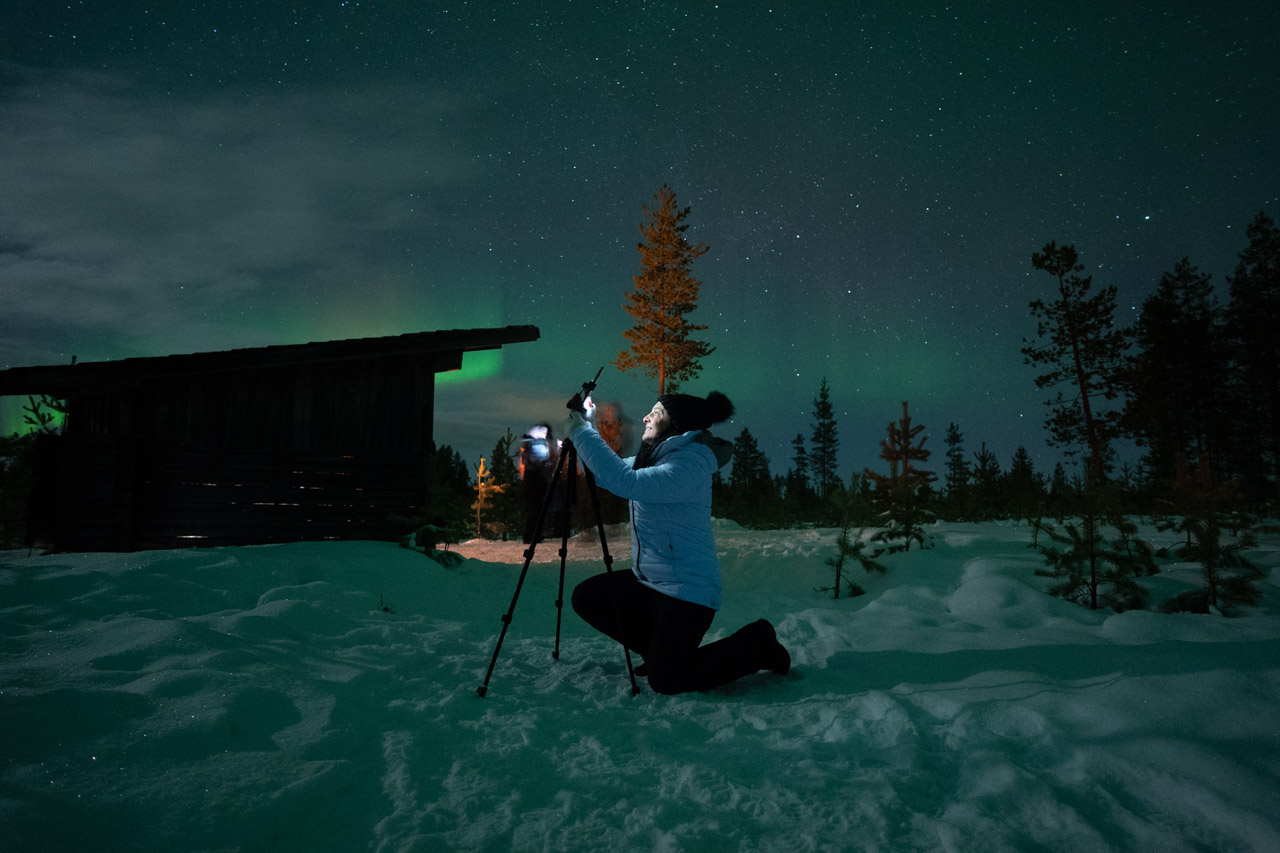
Two more points help in practice. In winter at Rovaniemi a bright moon crosses the southern half of the sky and the aurora usually appears in the north, so if you face north the moon is behind you. And the moon is only a problem while it is above the horizon, which brings us to timing.
When the moon is up, and when it isn't
The moon rises about 50 minutes later each night, so the phase decides which part of the night is dark.
- New moon and thin crescents: the moon rises and sets close to the sun, so the whole night is dark.
- First quarter: the moon sets around midnight, so the late night is dark.
- Full moon: the moon is up for most of the night, and in midwinter it stays high above the horizon.
- Last quarter: the moon rises around midnight, so the evening is dark and the late night is bright.
- Waning crescent: the moon rises just before dawn, so most of the night is dark.
This is why the days after the full moon are better than they sound. Each evening the moon comes up later, and the first part of the night gets dark again.
The moon this season
These are the new moon and full moon dates for Finnish time. They are accurate to the day, and the days either side behave much like them. The calendar on our conditions page shows every day of the month, with the percentage of the moon lit.
Darkest weeks (new moon): 9 November, 9 December, 7 January, 6 February, 8 March and 7 April.
Brightest nights (full moon): 24 November, 24 December, 22 January, 20 February and 22 March.
If you can choose, the week around a new moon gives you the darkest sky. But cloud cover decides more nights than the moon does, and the activity on the night matters too. A clear sky under a bright moon beats a cloudy sky under no moon every time.
What we do about it
We check the moon every night with the same data we use for cloud and activity, and we don't cancel a hunt because the moon is bright. On a near-full-moon night we lean harder on the activity numbers, pick a spot with an open view to the north, and take portraits where the snow is lit, since the light helps those. We stay out for as long as there is a realistic chance, and we count a sighting only if you can see it with your own eyes. That standard doesn't change with the phase of the moon.
If you're trying to decide on dates, send us a message with the nights you have. We'll tell you plainly what the moon and the forecast look like for them.
Share this article